
If AI Doesn't Suggest You, You Don't Exist: Getting Your Business Ready for the Age of AI
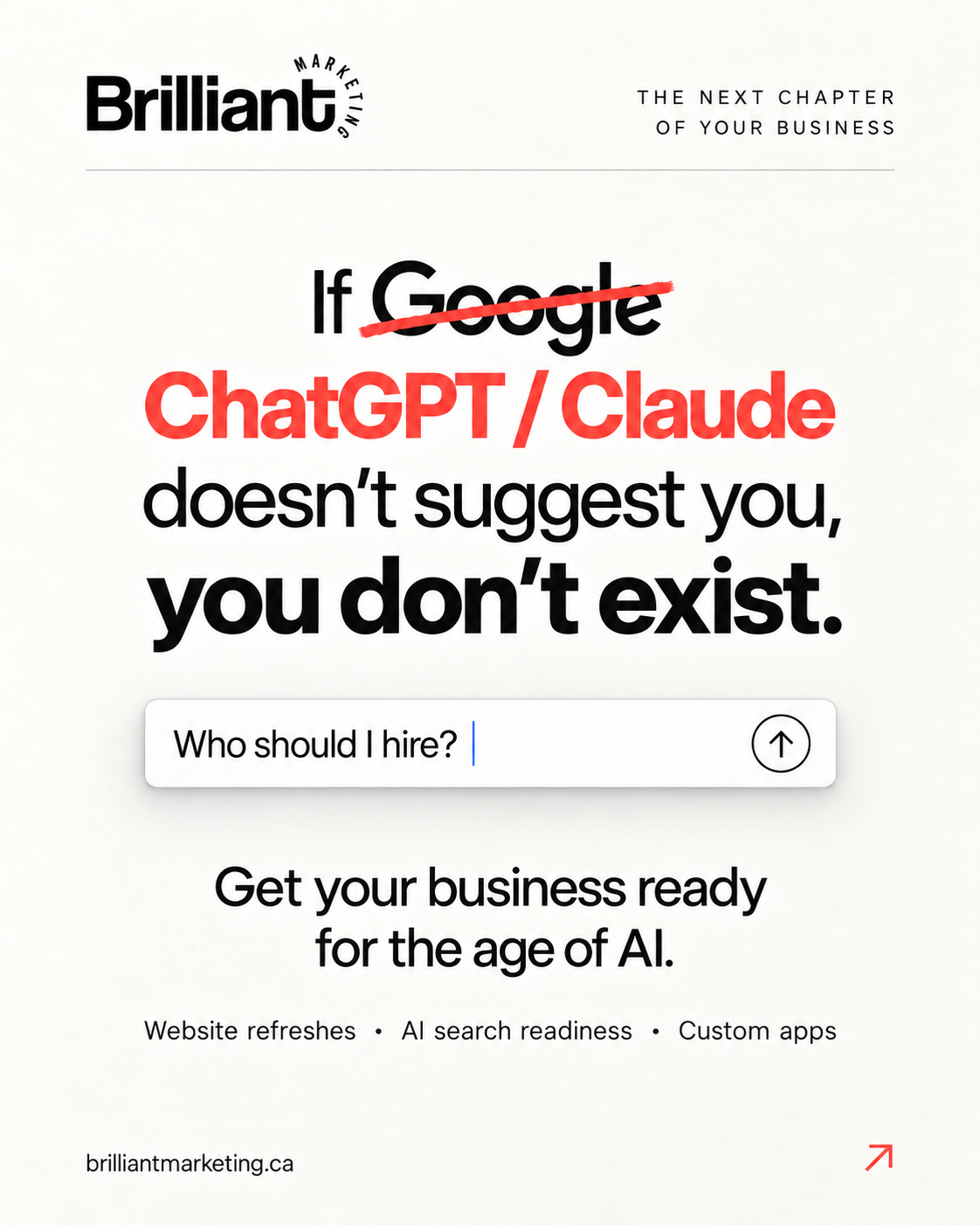
If ChatGPT, Claude, or Gemini doesn't suggest your business when someone asks who to hire, you don't exist. Here's how to build the foundation that earns AI recommendations — before your competitors do.
Written by the Brilliant Marketing team · Edmonton, Alberta
Remember when showing up on page one of Google was the entire game? You'd optimize your keywords, build backlinks, and wait for the traffic to roll in.
That world is shifting — fast.
Today, when someone asks ChatGPT, Claude, or Gemini "Who should I hire for marketing in Edmonton?" or "What's the best local CRM for a plumbing business?", there are no blue links to click. There's just an answer. And if your business isn't in that answer, you don't exist.
If AI doesn't suggest you, you don't exist.
This isn't a reason to panic. It's a reason to get your foundation right — right now, while most of your competitors are still treating SEO like it's 2018.
The Foundation Still Matters (Maybe More Than Ever)
Here's the thing that surprises people: AI search engines still rely on the same underlying signals that Google does. They crawl the web. They read your content. They look for authority, relevance, and consistency.
So before you chase anything new, make sure the basics are rock solid:
→ Your website is fast, mobile-first, and technically clean. AI models can't recommend what they can't read. A broken, slow, or poorly-structured site is invisible to them.
→ Your content is genuinely useful and specific. Not keyword-stuffed. Not generic. Real answers to the real questions your customers ask — written in plain language by a real human.
→ Your business information is consistent everywhere. Same name, same address, same phone, same story — across your website, Google Business Profile, directories, and social platforms. Consistency is how AI models trust that you are who you say you are.
If your SEO foundation is weak, nothing else you do to prepare for AI search will stick. Fix the foundation first.
Being Suggested, Not Just Found
Here's where the shift really hits. Traditional SEO was about being found — someone types a query, you show up in the list. AI search is about being suggested — someone asks a question in natural language, and the AI names you as the answer.
These are different muscles.
To be suggested by an AI, you need what we call recommendation signals — the kinds of things that make an AI model confidently name you when it's composing an answer:
1. Be talked about, in the right places. AI models learn from the whole web — not just your site. If authoritative blogs, news outlets, industry directories, and review platforms mention your business, the AI sees that as social proof. Press features, podcast appearances, guest articles, and real customer reviews all matter.
2. Structure your content to answer questions. AI models love clear, quotable answers. When your website directly addresses common questions — "How much does a brand photoshoot cost?" "What's included in a website package?" — you make it easy for AI to lift your answer and use it.
3. Build topical authority, not just keyword density. Instead of one thin page targeting one keyword, create a cluster of genuinely helpful content around a topic. An AI model that sees you covering a subject deeply is more likely to recognize you as an authority on it.
4. Get reviewed, a lot, and recently. Fresh, detailed reviews on Google, Yelp, and industry platforms are a signal that your business is active and trusted. AI models weigh recency heavily.
The Future of Search Is Multi-Platform
The other thing that's changed: search no longer starts and ends at Google.
Your next customer might ask ChatGPT for a recommendation. They might search TikTok for a local service provider. They might ask Alexa. They might type a question into Perplexity. Each of these platforms pulls from different sources and ranks things differently.
Being ready for the age of AI means being present and consistent everywhere your customers might look — not just ranking on one search engine.
That means:
→ A real, active Google Business Profile → Updated listings on the directories that matter in your industry → Social profiles that are alive (not abandoned in 2023) → Content that travels — that answers questions people actually ask, in the places they ask them
What This Looks Like in Practice
If that sounds overwhelming, here's the simple version: the businesses that win the AI search era are the ones that have always been winning — clear messaging, useful content, strong reviews, and a presence that feels alive and trustworthy.
The tactics change. The principles don't.
Start with three things:
-
Audit your website for speed, clarity, and mobile experience. If it's broken or outdated, fix it — this is non-negotiable.
-
Make a list of the 10 questions your customers actually ask you, and write a clear, honest, specific answer to each one on your website.
-
Commit to being present — one real review request per week, one piece of genuinely useful content per month, one directory or platform where you're not yet listed but should be.
Do those three things consistently for six months and you'll be further ahead than 90% of the businesses in your market.
We Can Help
At Brilliant Marketing, we're building for this shift — not chasing it. We help small businesses get their foundation right, build the kind of presence that earns AI recommendations, and create the content that makes sure you're the answer — not the afterthought.
Website refreshes. AI search readiness. Custom apps. All tailored to how your business actually works.
If you're not sure where you stand, that's exactly where we start. Reach out and we'll walk you through it — no jargon, no pressure.
Ready to Grow?